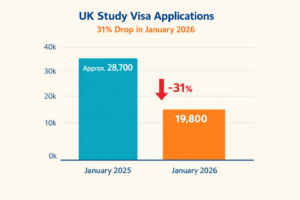

The sharp fall in UK study visas in January 2026 marks one of the clearest signals yet that Britain’s migration tightening is translating into measurable declines. Applications for UK study visas dropped by 31% compared to the same period last year, according to the latest report. The slowdown did not occur in isolation. Work and care visa routes also recorded steep declines, reinforcing the sense that the UK’s immigration system is entering a contraction phase.
UK study visas have long served as a pillar of Britain’s migration inflows. International students contribute billions in tuition revenue and local spending. Universities depend on them to balance budgets, fund research, and sustain postgraduate programs. A drop of this scale raises immediate concerns for higher education institutions already adjusting to policy shifts.
Recent rule changes have played a role. Restrictions on dependants for most postgraduate taught students and tighter salary thresholds across work routes have altered the attractiveness of the UK as a destination. While the government has framed these reforms as necessary to reduce net migration, the early data suggests demand is responding quickly.
The decline in care visas is equally significant. The social care sector had relied heavily on overseas recruitment to address workforce shortages. A plunge in applications may intensify staffing pressures across care homes and community services. Employers who expanded hiring pipelines abroad may now face renewed gaps.
For policymakers, the fall in UK study visas presents both validation and risk. On one hand, reduced application numbers align with stated goals to lower migration levels. On the other, international education functions as a major export sector. A sustained decline could affect university finances, regional economies, and Britain’s global academic standing.
The January figures offer a snapshot rather than a full-year forecast. Seasonal patterns can influence visa data. Yet the simultaneous drop across study, work, and care routes suggests structural impact rather than temporary fluctuation.
Prospective students are also weighing broader factors. Visa stability, post-study work rights, and long-term settlement options influence decision-making. Competing destinations such as Canada and Australia continue to position themselves as attractive alternatives in global education markets.
If UK study visas continue to trend downward, institutions may need to adjust recruitment strategies, diversify source markets, or reassess financial models. Government departments may also face pressure to balance migration targets with economic realities tied to international education.
The coming months will be critical. Visa data across spring and summer intake cycles will clarify whether January represents an early warning or the start of a sustained reset. For now, the message is unmistakable. The UK study visa landscape is cooling, and its ripple effects may extend far beyond campus gates.