
Read Our Latest Blogs

Skyline of New York City representing immigration decline and slowing population growth.

Historic Migration Fall Pushes New York Into Demographic Standstill

Summary Points

  • New York added just 1,008 residents in 2024–25
  • Net US migration fell from 2.7 million to 1.3 million
  • Immigrant arrivals to New York dropped to 96,000
  • State lost 137,000 residents to other US states
  • Births narrowly offset migration losses
  • Experts warn of economic impact from immigration slowdown

New York Immigration Decline Pushes State Into Near Population Freeze

New York immigration decline has reshaped the state’s demographic landscape. After a brief rebound following the pandemic, growth has stalled.

Between July 2024 and July 2025, New York added just 1,008 residents. The state’s population now sits slightly above 20 million, still below its 2020 Census level.

Immigration Drop Reverses Recent Surge

The New York immigration decline is closely linked to a national slowdown. Net international migration to the United States fell sharply from 2.7 million to 1.3 million in a single year.

In 2023–24, New York recorded more than 290,000 foreign arrivals, the highest annual total in decades. That surge has now reversed. Only around 96,000 immigrants arrived between July 2024 and July 2025, marking a two-thirds decline.

Border pressures, housing affordability challenges, and work authorization delays have influenced migration patterns. Rising rents and limited housing supply have made it difficult for newcomers to remain in the state.

Domestic Outmigration and Economic Risks

The New York immigration decline is compounded by domestic outmigration. The state lost 137,000 residents to other states in the most recent year. Since 2020, more than 1 million residents have left for other parts of the country.

Births slightly exceeded deaths, with 203,000 births compared to 160,000 deaths. This natural increase narrowly offset migration losses.

Economists warn that reduced immigration could impact labour supply in construction, healthcare, childcare, and food services. With 4.6 million foreign-born residents statewide, immigration remains central to New York’s economic structure.

Without sustained inflows, experts caution that the state’s long-term growth and tax base may face mounting pressure.


Image representing Reform UK deportation agency proposal targeting illegal migration and small boat crossings.

Reform UK Vows ICE-Style Deportation Agency in Hardline Migration Push

Summary Points

  • Reform UK proposes ICE-style deportation agency

  • Agency could remove up to 288,000 illegal migrants annually

  • “Illegal Migration Mass Deportation Act” planned

  • Over 41,000 small boat arrivals recorded in 2025

  • Labour says nearly 60,000 removals since 2024

  • Visa bans and benefit restrictions also proposed

Reform UK has unveiled one of its most detailed immigration proposals to date, centered on establishing a Reform UK deportation agency with powers comparable to U.S. Immigration and Customs Enforcement.

Mass Deportation Strategy and Legal Overhaul

The proposed Reform UK deportation agency would operate under a new “Illegal Migration Mass Deportation Act.” The legislation aims to legally compel removals and limit judicial intervention in deportation cases.

Party officials claim the agency could remove up to 288,000 individuals per year. They frame the measure as necessary to address what they describe as a national security emergency.

In 2025, more than 41,000 asylum seekers arrived in the UK by small boat crossings across the Channel. This remains a major political flashpoint despite an overall decline in net migration figures last year.

The party has also suggested withdrawing from certain human rights treaties if they obstruct deportation enforcement.

Broader Immigration and Benefits Proposals

Beyond enforcement, Reform UK proposes halting benefit payments to foreign nationals. The party has also pledged to impose visa bans on countries such as Pakistan, Somalia, Eritrea, Syria, Afghanistan, and Sudan if they refuse to accept deported nationals.

The governing Labour Party disputes Reform’s framing. Officials state nearly 60,000 people without legal status have been removed since 2024.

The Reform UK deportation agency proposal reflects a broader political contest over immigration policy ahead of the next general election. Migration levels, asylum procedures, and border enforcement remain central voter concerns.

Traveler at airport check-in counter highlighting new UK Electronic Travel Authorisation requirement effective February 2026.

UK Electronic Travel Authorisation Now Fully Enforced at Border

Summary Points

  • Spain migrant regularization could grant legal status to around 500,000 undocumented residents.
  • The draft decree is currently in public consultation.
  • Eligible applicants must have been in Spain before December 31, 2025 and prove five months of continuous presence.
  • Successful applicants will receive one-year legal residence with the right to work.
  • Children may receive five-year residence permits.
  • The measure does not grant automatic citizenship.
  • It does not provide voting rights in national or regional elections.
  • Spain’s last major regularization in 2005 legalized about 576,000 migrants and increased tax revenues.

The UK Electronic Travel Authorisation is officially mandatory from 25 February 2026. Non-visa nationals who fail to secure digital travel permission will be denied boarding by airlines.

Who Needs an ETA and How It Works

The UK Electronic Travel Authorisation applies to nationals from 85 countries, including the United States, Canada, and France. Visitors must apply online or through the UK ETA app before traveling.

The permit costs £16 and allows multiple entries for up to two years or until the passport expires. Once approved, the ETA is digitally linked to the traveler’s passport.

Travelers connecting through the UK and passing passport control must also hold an ETA. Airlines are responsible for checking compliance prior to boarding.

British and Irish citizens are exempt. However, they must travel using a valid British passport or Certificate of Entitlement.

Revenue, Digital Expansion, and Border Security Goals

Since October 2023, more than 19 million ETAs have been approved. By January 2026, the system generated over £383 million in revenue, reinvested into border and immigration improvements.

The UK Electronic Travel Authorisation supports the broader digitisation of immigration controls. More than 10 million eVisas have already been issued as part of the transition away from physical documents.

Officials state that the ETA system strengthens security screening by identifying potential threats before arrival. Most applications are processed automatically within minutes, although travelers are advised to apply at least three working days in advance.

The enforcement marks a significant step toward a contactless UK border system.

Undocumented migrants waiting outside an immigration office in Spain as part of the Spain migrant regularization process.

Spain Moves to Legalize 500,000 Migrants in Historic Regularization Plan | Spain Migrant Regularization:

Summary Points

  • Spain migrant regularization could grant legal status to around 500,000 undocumented residents.
  • The draft decree is currently in public consultation.
  • Eligible applicants must have been in Spain before December 31, 2025 and prove five months of continuous presence.
  • Successful applicants will receive one-year legal residence with the right to work.
  • Children may receive five-year residence permits.
  • The measure does not grant automatic citizenship.
  • It does not provide voting rights in national or regional elections.
  • Spain’s last major regularization in 2005 legalized about 576,000 migrants and increased tax revenues.

Spain migrant regularization is back at the center of national debate as the government advances a decree that could grant legal status to around 500,000 undocumented residents. The draft is now in public consultation under the Real Decreto process, marking the first large-scale regularization effort in more than twenty years.

The government presents the measure as a pragmatic response to an existing reality. Hundreds of thousands of migrants are already living and working in Spain without formal status. Many are embedded in sectors that depend heavily on migrant labor. Spain migrant regularization aims to bring these individuals into the legal framework and reduce exploitation within the informal economy.

Who Qualifies Under the Spain Migrant Regularization Plan?

Eligibility criteria are clearly defined. Applicants must have been physically present in Spain before December 31, 2025. They must prove at least five months of continuous presence at the time of application. A clean criminal record is required.

Asylum seekers who applied before the cut-off date may also fall within scope.

If approved, applicants will receive a one-year residence authorization. This permit includes the right to work anywhere in Spain and across any sector. Once the application is formally admitted, individuals may begin working legally while their case is being processed.

Children already residing in Spain may receive five-year residence permits. The government frames this as a measure to support family stability and integration.

Importantly, Spain migrant regularization does not grant automatic citizenship. Nationality follows separate legal pathways. In most cases, ten years of legal residence are required. The measure also does not provide voting rights in national or regional elections.

What Happened After Spain’s 2005 Regularization?

Spain last implemented a major regularization in 2005. Around 576,000 undocumented migrants were granted legal status at that time.

Subsequent research found measurable economic effects. Tax revenues increased. Social security contributions rose. Many migrants transitioned from informal employment into regulated labor markets. Studies did not find strong evidence that the measure triggered a large surge in new irregular migration.

However, legal status did not eliminate structural inequalities. Wage gaps between migrants and native workers persisted, reflecting broader labor market segmentation.

Spain in 2026 faces different pressures compared to two decades ago. Housing shortages, labor shifts, and political polarization create a more complex environment. Supporters argue that Spain migrant regularization strengthens oversight and integrates workers into the formal economy. Critics question timing and long-term impact.

The ultimate outcome will depend on implementation. Administrative capacity, processing timelines, and labor enforcement will shape results. The legal text sets the framework. Execution will determine whether Spain migrant regularization achieves its intended goals.

Graphic highlighting migrant benefits exceeding £15 billion over 18 months, based on Universal Credit payments data.

£15 Billion in 18 Months: Migrant Benefits Row Explodes Across UK

Summary Points

  • Migrant households reportedly received over £15 billion in benefits within 18 months.
  • £9.5 billion in Universal Credit was paid in 2024.
  • £5.6 billion was paid in the first half of 2025.
  • Of the 2024 total, £6.7 billion went to households where the foreign-national claimant was not working.
  • The figures are calculated at household level, meaning payments may include British partners or children.
  • Some claimants listed as unemployed may be self-employed with irregular earnings.
  • The government plans to double the benefits waiting period to 10 years for most migrants.
  • Political debate over migration and welfare access has intensified.

The debate over migrant households benefits has reignited after new figures claimed more than £15 billion was paid out over just 18 months. The data, obtained through Freedom of Information requests, has intensified scrutiny of welfare access for foreign-national claimants in the United Kingdom.

According to the study, £9.5 billion in Universal Credit was distributed during 2024. An additional £5.6 billion was paid in the first half of 2025. Together, the total surpasses £15 billion within a year and a half. Of the 2024 payments, £6.7 billion went to households where the foreign-national claimant was not in employment.

The migrant households benefits data is calculated at household level. This distinction matters. Payments may support British partners or children living in the same household. In some cases, claimants recorded as unemployed may be self-employed with low or irregular earnings. These nuances form part of the broader policy debate.

Supporters of tighter migration rules argue the figures highlight fiscal pressure. They claim that rising benefit payments linked to foreign-national households justify stricter eligibility criteria. Some have proposed ending benefits access for non-working foreign nationals entirely.

The government has signalled a firmer stance. Plans are underway to double the standard waiting period before most migrants can access benefits, extending it to 10 years. Ministers have also stated that migrants should contribute before accessing welfare support. The policy direction indicates a shift toward contribution-based eligibility.

Opposition parties have pushed for even tougher limits. Welfare spending remains politically sensitive. When linked to migration levels, it becomes central to electoral debate.

The migrant households benefits issue sits at the intersection of immigration control and social policy. On one side is the argument for fiscal restraint and prioritising taxpayers. On the other is the recognition that households often contain mixed-nationality members, including British citizens.

The figures do not exist in isolation. Universal Credit supports low-income households regardless of nationality, provided eligibility rules are met. Yet public perception often focuses on headline totals rather than structural detail.

The coming months may bring further clarification. Government consultations on benefit access rules are expected. The 10-year waiting proposal, if implemented, would mark a substantial policy change.

For now, migrant households benefits remain at the heart of the UK’s political conversation. The numbers have reignited an already heated national debate.

International student sitting on campus steps looking thoughtful, representing the 31% decline in UK Study Visas in January 2026.

UK Visa Demand Crashes 31% as Study Visa and Work Routes Slide

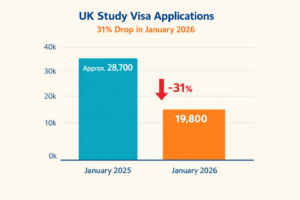
The sharp fall in UK study visas in January 2026 marks one of the clearest signals yet that Britain’s migration tightening is translating into measurable declines. Applications for UK study visas dropped by 31% compared to the same period last year, according to the latest report. The slowdown did not occur in isolation. Work and care visa routes also recorded steep declines, reinforcing the sense that the UK’s immigration system is entering a contraction phase.

UK study visas have long served as a pillar of Britain’s migration inflows. International students contribute billions in tuition revenue and local spending. Universities depend on them to balance budgets, fund research, and sustain postgraduate programs. A drop of this scale raises immediate concerns for higher education institutions already adjusting to policy shifts.

Recent rule changes have played a role. Restrictions on dependants for most postgraduate taught students and tighter salary thresholds across work routes have altered the attractiveness of the UK as a destination. While the government has framed these reforms as necessary to reduce net migration, the early data suggests demand is responding quickly.

The decline in care visas is equally significant. The social care sector had relied heavily on overseas recruitment to address workforce shortages. A plunge in applications may intensify staffing pressures across care homes and community services. Employers who expanded hiring pipelines abroad may now face renewed gaps.

For policymakers, the fall in UK study visas presents both validation and risk. On one hand, reduced application numbers align with stated goals to lower migration levels. On the other, international education functions as a major export sector. A sustained decline could affect university finances, regional economies, and Britain’s global academic standing.

The January figures offer a snapshot rather than a full-year forecast. Seasonal patterns can influence visa data. Yet the simultaneous drop across study, work, and care routes suggests structural impact rather than temporary fluctuation.

Prospective students are also weighing broader factors. Visa stability, post-study work rights, and long-term settlement options influence decision-making. Competing destinations such as Canada and Australia continue to position themselves as attractive alternatives in global education markets.

If UK study visas continue to trend downward, institutions may need to adjust recruitment strategies, diversify source markets, or reassess financial models. Government departments may also face pressure to balance migration targets with economic realities tied to international education.

The coming months will be critical. Visa data across spring and summer intake cycles will clarify whether January represents an early warning or the start of a sustained reset. For now, the message is unmistakable. The UK study visa landscape is cooling, and its ripple effects may extend far beyond campus gates.

Bar chart showing a 31% decline in UK Study Visas from January 2025 to January 2026, with applications falling to 19,800.
a graduation cap and cash shown with title The New Costs of Immigration in New Zealand Could Migrants, Schools, and Employers Pay More

The New Costs of Immigration in New Zealand: Could Migrants, Schools, and Employers Pay More?

➡️New Zealand has proposed a new amendment aimed at improving the fiscal sustainability and strengthening the development of the immigration system.

➡️Once these changes are in place, we can expect noticeable shifts in costs across several areas of immigration.

➡️Out of the ten proposed amendments, two are directly linked to the fiscal sustainability of the system, and those are the ones we will focus on here.

➡️At this stage, it is not yet clear whether the current levy paid by existing levy payers will be increased, or whether their levy will stay the same with a separate extended levy introduced for new stakeholders such as employers and education providers.

Amendment 1 – Expanding the Immigration Levy Base

What is changing

The immigration levy is currently paid mainly by certain visa applicants. Under the new rules, more groups would contribute:

  • Employers who hire people on temporary work visas.
  • Education providers who enrol fee-paying international students.

Why this matters

The aim is to shift a greater share of the cost to those who directly benefit from immigration, such as businesses that gain skilled labour and schools that receive international student fees.

Potential fiscal impact

  • This change could increase total levy revenue for the country, but the overall expense of the international students or the workers might increase.
  • The additional funds would help cover more of the system’s operational expenses.

Amendment 2 – Expanding How Levy Revenue Can Be Used

What is changing

At the moment, levy funds are mostly used for immigration-related services. The amendment allows the levy to also support:

  • Education system: building school facilities, funding specialist teachers, teacher training, and learning support, where demand is linked to immigration.
  • Health system: covering extra costs caused by parent visas.
  • Skills training: helping to train the domestic workforce, especially in areas where employers bring in already skilled workers from overseas.

Why this matters

The government is linking levy spending directly to public service costs that rise with immigration.

Potential fiscal impact

  • Levy funds could be redirected to these areas to meet demand.
  • Employers hiring from overseas would contribute to training costs that would otherwise be met through other funding sources.
Which Indians in New Zealand Qualify for SMC and AEWV Education Points Without an Assessment

Which Indians in New Zealand Qualify for SMC and AEWV Education Points Without an Assessment? A Study of the 2025 LQEA Amendment

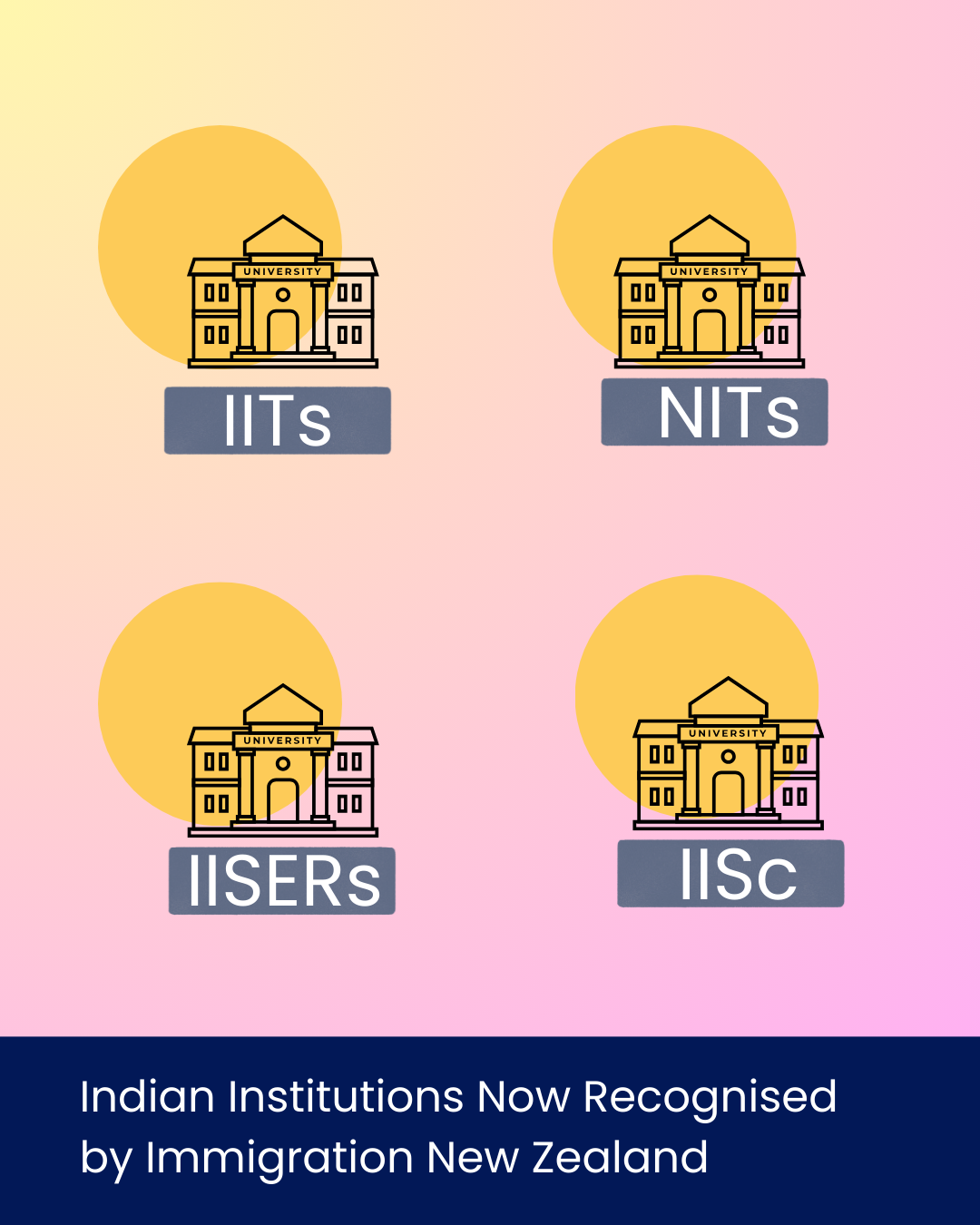
If you have studied these courses in the designated universities in India, you will be exempted from the International Qualification Assessment.

The List of Qualifications Exempt from Assessment is a long-standing list. INZ has added India and several other countries to it recently, which includes France, Germany, Italy, Singapore, South Korea, Sri Lanka, Sweden, and Switzerland.

On 18 June 2025, Immigration New Zealand issued a new Amendment Circular, which introduced a new List of Qualifications Exempt from Assessment. India has been added to this list, alongside several other countries. This means Indian applicants who are seeking to migrate to New Zealand, whether through the Skilled Migrant Category residence visa (SMC) or certain work visas, do not need to go through the IQA and can directly claim the points.

Which Indians in New Zealand Qualify for SMC and AEWV Education Points Without an Assessment

How to Read the Table  

If you hold a Bachelor’s or Master’s degree from IISc Bangalore, it will be automatically recognised in New Zealand under the LQEA. A Bachelor’s degree is treated as a Level 7 qualification and gives 3 points under the Skilled Migrant Category, while a Master’s degree is treated as Level 9 and gives 5 points. However, this only applies if your degree was awarded in 2012 or later. Degrees completed before 2012 will still require an NZQA International Qualification Assessment.

Indian Institutes of Technology (IIT) & IISER / IISc 

Institution

Qualification

NZQCF Level

Effective From

SMC Points*

IIT Bhilai

Bachelor’s, Master’s

Level 7, 9

From 2014

3, 5

IIT Bhubaneswar

Bachelor’s, Master’s

Level 7, 9

From 2007

3, 5

IISER Bhopal

Bachelor’s, Master’s

Level 7, 9

From 2016

3, 5

IISER Kolkata

Bachelor’s, Master’s

Level 7, 9

From 2008

3, 5

IISER Berhampur

Bachelor’s, Master’s

Level 7, 9

From 2016

3, 5

IISER Mohali

Bachelor’s, Master’s

Level 7, 9

From 2007

3, 5

IISER Pune

Bachelor’s, Master’s

Level 7, 9

From 2007

3, 5

IISER Thiruvananthapuram

Bachelor’s, Master’s

Level 7, 9

From 2007

3, 5

IISER Tirupati

Bachelor’s, Master’s

Level 7, 9

From 2015

3, 5

IISc Bangalore

Bachelor’s, Master’s

Level 7, 9

From 2012

3, 5

IIT (BHU) Varanasi

Bachelor’s, Master’s

Level 7, 9

From 2012

3, 5

IIT Dharwad

Bachelor’s, Master’s

Level 7, 9

From 2016

3, 5

IIT Guwahati

Bachelor’s, Master’s

Level 7, 9

From 2012

3, 5

IIT Hyderabad

Bachelor’s, Master’s

Level 7, 9

From 2012

3, 5

IIT Indore

Bachelor’s, Master’s

Level 7, 9

From 2016

3, 5

IIT Jammu

Bachelor’s, Master’s

Level 7, 9

From 2016

3, 5

IIT Jodhpur

Bachelor’s, Master’s

Level 7, 9

From 2012

3, 5

IIT Kanpur

Bachelor’s, Master’s

Level 7, 9

From 2012

3, 5

IIT Kharagpur

Bachelor’s, Master’s

Level 7, 9

From 2012

3, 5

IIT Madras

Bachelor’s, Master’s

Level 7, 9

From 2012

3, 5

IIT Mandi

Bachelor’s, Master’s

Level 7, 9

From 2012

3, 5

IIT Mumbai (Bombay)

Bachelor’s, Master’s

Level 7, 9

From 2012

3, 5

IIT Palakkad

Bachelor’s, Master’s

Level 7, 9

From 2015

3, 5

IIT Patna

Bachelor’s, Master’s

Level 7, 9

From 2012

3, 5

IIT Roorkee

Bachelor’s, Master’s

Level 7, 9

From 2012

3, 5

IIT Delhi

Bachelor’s, Master’s

Level 7, 9

From 2012

3, 5

IIT Gandhinagar

Bachelor’s, Master’s

Level 7, 9

From 2012

3, 5

IIT Goa

Bachelor’s, Master’s

Level 7, 9

From 2016

3, 5

IIT Ropar

Bachelor’s, Master’s

Level 7, 9

From 2007

3, 5

IIT Tirupati

Bachelor’s, Master’s

Level 7, 9

From 2007

3, 5

IIT (ISM) Dhanbad

Bachelor’s, Master’s

Level 7, 9

From 2007

3, 5

(Source: https://www.immigration.govt.nz/)

National Institutes of Technology (NITs)

Institution

Qualification

NZQCF Level

Effective From

SMC Points*

Dr. B.R. Ambedkar NIT Jalandhar

Bachelor’s, Master’s

Level 7, 9

From 2007

3, 5

IIEST Shibpur

Bachelor’s, Master’s

Level 7, 9

From 2007

3, 5

NIT Delhi

Bachelor’s, Master’s

Level 7, 9

From 2012

3, 5

NIT Goa

Bachelor’s, Master’s

Level 7, 9

From 2015

3, 5

NIT Jamshedpur

Bachelor’s, Master’s

Level 7, 9

From 2012

3, 5

NIT Karnataka (Surathkal)

Bachelor’s, Master’s

Level 7, 9

From 2007

3, 5

NIT Kurukshetra

Bachelor’s, Master’s

Level 7, 9

From 2007

3, 5

NIT Andhra Pradesh

Bachelor’s, Master’s

Level 7, 9

From 2007

3, 5

NIT Arunachal Pradesh

Bachelor’s, Master’s

Level 7, 9

From 2007

3, 5

NIT Calicut

Bachelor’s, Master’s

Level 7, 9

From 2015

3, 5

NIT Hamirpur

Bachelor’s, Master’s

Level 7, 9

From 2007

3, 5

NIT Durgapur

Bachelor’s, Master’s

Level 7, 9

From 2007

3, 5

NIT Manipur

Bachelor’s, Master’s

Level 7, 9

From 2009

3, 5

NIT Meghalaya

Bachelor’s, Master’s

Level 7, 9

From 2007

3, 5

NIT Mizoram

Bachelor’s, Master’s

Level 7, 9

From 2009

3, 5

NIT Nagaland

Bachelor’s, Master’s

Level 7, 9

From 2009

3, 5

NIT Patna

Bachelor’s, Master’s

Level 7, 9

From 2007

3, 5

NIT Puducherry

Bachelor’s, Master’s

Level 7, 9

From 2007

3, 5

NIT Raipur

Bachelor’s, Master’s

Level 7, 9

From 2007

3, 5

NIT Rourkela

Bachelor’s, Master’s

Level 7, 9

From 2007

3, 5

NIT Sikkim

Bachelor’s, Master’s

Level 7, 9

From 2009

3, 5

NIT Silchar

Bachelor’s, Master’s

Level 7, 9

From 2007

3, 5

NIT Srinagar

Bachelor’s, Master’s

Level 7, 9

From 2007

3, 5

NIT Tiruchirapalli

Bachelor’s, Master’s

Level 7, 9

From 2007

3, 5

NIT Uttarakhand

Bachelor’s, Master’s

Level 7, 9

From 2009

3, 5

NIT Warangal

Bachelor’s, Master’s

Level 7, 9

From 2007

3, 5

SVNIT Surat

Bachelor’s, Master’s

Level 7, 9

From 2007

3, 5

VNIT Nagpur

Bachelor’s, Master’s

Level 7, 9

From 2007

3, 5

MNIT Jaipur

Bachelor’s, Master’s

Level 7, 9

From 2007

3, 5

MANIT Bhopal

Bachelor’s, Master’s

Level 7, 9

From 2007

3, 5

MNNIT Allahabad

Bachelor’s, Master’s

Level 7, 9

From 2007

3, 5

(Source: https://www.immigration.govt.nz/)

What Is the LQEA?

The List of Qualifications Exempt from Assessment, commonly known as LQEA, identifies overseas qualifications that do not require an International Qualification Assessment by the New Zealand Qualifications Authority when used for immigration purposes.

Normally, applicants must apply to NZQA to confirm whether their overseas qualification is comparable to a New Zealand qualification. This process can take months and involve fees. However, if a qualification appears on the LQEA, INZ will automatically recognise it at a specified New Zealand Qualifications and Credentials Framework level.

It is important to emphasize that this exemption is only for immigration purposes. It does not affect professional registration, eligibility for further study, or how employers might evaluate the qualification for salary purposes.

Who Benefits from This Change?

Along with many new countries, Indian nationals applying under two major categories benefit from the new recognition:

Skilled Migrant Category (Residence Visa)

  • Applicants must meet the points threshold (a minimum of 6 points).
  • Points can be claimed from qualifications, skilled work experience, income, or occupational registration.
  • With Indian qualifications now exempt under the LQEA, applicants can claim points for their degree without needing to submit an NZQA IQA.

Work Visa Applications

  • Particularly relevant for the Accredited Employer Work Visa and Green List occupations.
  • Applicants can demonstrate that they meet minimum qualification requirements without NZQA assessment, provided their qualification is listed in Appendix 17.

This change effectively removes a key administrative barrier for many skilled workers from India.

Conditions That Must Be Met

Although being on the LQEA eliminates the need for NZQA assessment, the exemption is subject to strict conditions. A qualification will only be accepted if:

  1. The qualification and the awarding institution are listed in Appendix 17.
  2. The qualification was awarded in or after the year stated in the “effective from” column.
  3. The qualification was awarded in India itself, not at an overseas campus.
  4. Any additional notes or requirements attached to the qualification are satisfied.
  5. The full-time duration is clear and standard. If the duration cannot be determined, INZ may still require an IQA.

Failure to meet any of these conditions means the applicant must revert to the standard IQA process.

Engineering Degrees and International Accords

Special provisions exist for engineering qualifications through the Washington Accord (professional engineering degrees) and Sydney Accord (engineering technology degrees).

  • India has been a signatory to the Washington Accord since 2014, through accreditation by the National Board of Accreditation.
  • Degrees accredited under these accords are recognized as equivalent to Level 7 on the NZQCF and attract 3 points under the Skilled Migrant Category.
  • If there is any doubt, INZ may require confirmation from Engineering New Zealand, formerly IPEZ, that the degree meets the accord requirements.

Limitations and Exclusions

While the recognition of Indian qualifications under the LQEA is a significant step forward, there are clear limitations:

  • The LQEA does not guarantee professional registration (e.g., for teachers, engineers, or health professionals).
  • It does not establish equivalency for academic progression in New Zealand universities.
  • It does not automatically influence employment conditions, such as salary scales.
  • Teachers, for example, must still apply for a Teaching International Qualification Assessment.

Applicants must therefore distinguish between immigration recognition and professional or academic recognition.

Read Out Latest

Skyline of New York City representing immigration decline and slowing population growth.

Historic Migration Fall Pushes New York Into Demographic Standstill

Summary Points New York added just 1,008 residents in 2024–25 Net US migration fell from 2.7 million to 1.3 million Immigrant arrivals to New York dropped to 96,000 State lost 137,000 residents to other US states Births narrowly offset migration losses Experts warn of economic impact from immigration slowdown New York Immigration Decline Pushes State...Continue reading

Image representing Reform UK deportation agency proposal targeting illegal migration and small boat crossings.

Reform UK Vows ICE-Style Deportation Agency in Hardline Migration Push

Summary Points Reform UK proposes ICE-style deportation agency Agency could remove up to 288,000 illegal migrants annually “Illegal Migration Mass Deportation Act” planned Over 41,000 small boat arrivals recorded in 2025 Labour says nearly 60,000 removals since 2024 Visa bans and benefit restrictions also proposed Reform UK has unveiled one of its most detailed immigration...Continue reading

Traveler at airport check-in counter highlighting new UK Electronic Travel Authorisation requirement effective February 2026.

UK Electronic Travel Authorisation Now Fully Enforced at Border

Summary Points Spain migrant regularization could grant legal status to around 500,000 undocumented residents. The draft decree is currently in public consultation. Eligible applicants must have been in Spain before December 31, 2025 and prove five months of continuous presence. Successful applicants will receive one-year legal residence with the right to work. Children may receive...Continue reading

Undocumented migrants waiting outside an immigration office in Spain as part of the Spain migrant regularization process.

Spain Moves to Legalize 500,000 Migrants in Historic Regularization Plan | Spain Migrant Regularization:

Summary Points Spain migrant regularization could grant legal status to around 500,000 undocumented residents. The draft decree is currently in public consultation. Eligible applicants must have been in Spain before December 31, 2025 and prove five months of continuous presence. Successful applicants will receive one-year legal residence with the right to work. Children may receive...Continue reading

Graphic highlighting migrant benefits exceeding £15 billion over 18 months, based on Universal Credit payments data.

£15 Billion in 18 Months: Migrant Benefits Row Explodes Across UK

Summary Points Migrant households reportedly received over £15 billion in benefits within 18 months. £9.5 billion in Universal Credit was paid in 2024. £5.6 billion was paid in the first half of 2025. Of the 2024 total, £6.7 billion went to households where the foreign-national claimant was not working. The figures are calculated at household...Continue reading

a graduation cap and cash shown with title The New Costs of Immigration in New Zealand Could Migrants, Schools, and Employers Pay More

The New Costs of Immigration in New Zealand: Could Migrants, Schools, and Employers Pay More?

➡️New Zealand has proposed a new amendment aimed at improving the fiscal sustainability and strengthening the development of the immigration system. ➡️Once these changes are in place, we can expect noticeable shifts in costs across several areas of immigration. ➡️Out of the ten proposed amendments, two are directly linked to the fiscal sustainability of the...Continue reading

Which Indians in New Zealand Qualify for SMC and AEWV Education Points Without an Assessment

Which Indians in New Zealand Qualify for SMC and AEWV Education Points Without an Assessment? A Study of the 2025 LQEA Amendment

If you have studied these courses in the designated universities in India, you will be exempted from the International Qualification Assessment. The List of Qualifications Exempt from Assessment is a long-standing list. INZ has added India and several other countries to it recently, which includes France, Germany, Italy, Singapore, South Korea, Sri Lanka, Sweden, and...Continue reading